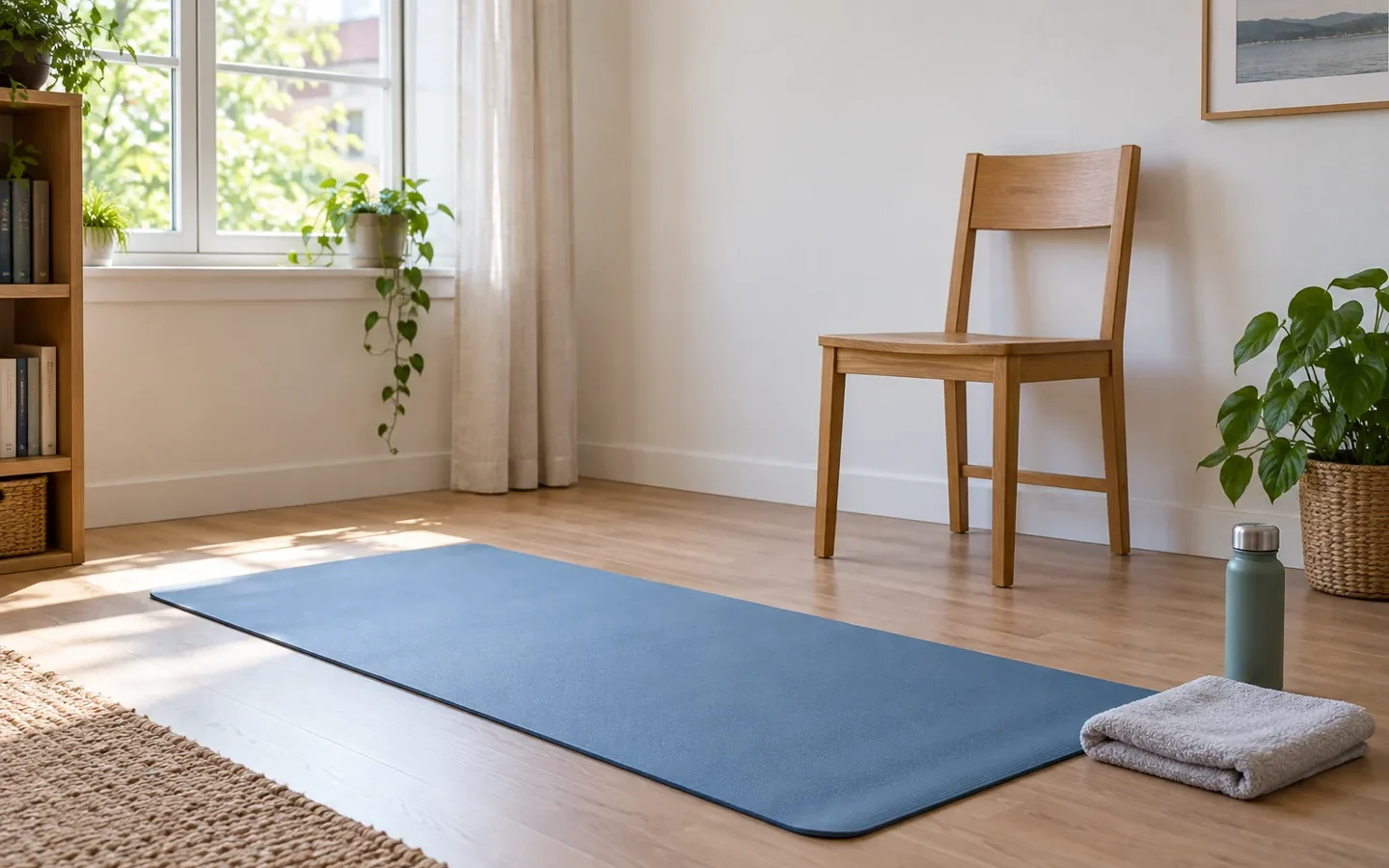
Image: an AI-generated editorial illustration of a home exercise space; it does not show a real session or fitness centre.
Bodyweight training need not involve acrobatics or a transformation within weeks. A more useful question is which movements you can practise with suitable technique and how they fit your life. Your starting point, limitations and available support matter more than a trend’s name.
Start with a manageable version
The NHS illustrates home strength exercises, including standing up from a chair and wall press-ups. It recommends a stable chair without wheels that will not slide, and building up gradually. Its instructions and images explain the movements; completing every suggested repetition on day one is not a requirement.
If you have an injury, a health condition or uncertainty about suitable activity, seek advice from a healthcare or appropriately qualified exercise professional. Stop an activity that causes pain or makes you feel unwell. This article is not a rehabilitation prescription.
Make your routine easy to review
- Choose a purpose: learning to control a movement, for example, rather than chasing a body measurement.
- Prepare the space: check the floor, supports and anything that could obstruct movement.
- Choose clear guidance: ask for help if you cannot understand the technique.
- Keep useful notes: record what you did, what was difficult and what you need to ask before changing your routine.
The WHO emphasises that all physical activity counts and some activity is better than none. Strength work is one part of an active life, not the only way to move or an automatic replacement for other activities.
Apps can organise a plan, but cannot guarantee an outcome
A reminder or exercise log may help you stay organised. That does not establish that an app correctly assesses every posture, understands your situation or prevents injury. Before following an automated plan, check its intended audience, available adaptations and advice about seeking help.
Correcting the former article
The earlier claims about an established “Bodyweight 2.0” method, extraordinary results and guaranteed injury reduction through artificial intelligence have been removed because they lacked sufficient evidence.
The reference to an “International Space Agency (ISS)” was also incorrect. ISS means International Space Station. NASA describes specialised equipment such as ARED, which creates resistance in microgravity. This does not support the equipment-free astronaut programme claimed in the previous version.
Sources checked on 23 September 2026. Explore more Buscatea guides.