Image: AI-generated editorial illustration; a fictional scene with no real businesses.
Your first embroidery need not become a framed picture. A cotton offcut, small hoop and two colours of thread give you room to learn how the needle moves without risking a favourite shirt. Finish a sample that teaches you something; perfect stitches can wait.
Work at a well-lit table and put the needle away when you pause. If the fabric puckers or the thread pulls too tightly, adjust the tension before adding more stitches.
Make a sample you can finish
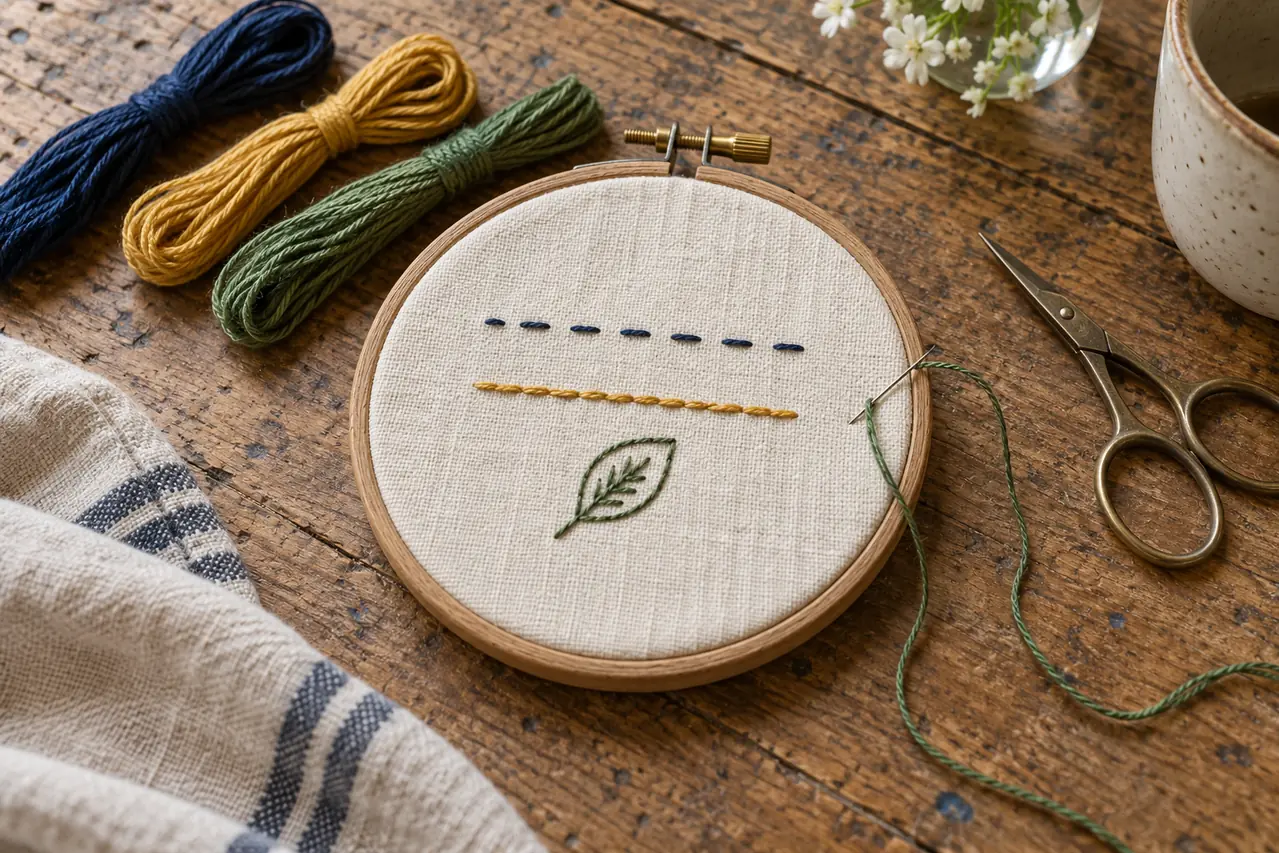
Fit the fabric in the hoop so it is smooth and firm, not stretched out of shape. Mark three short guides with a tool suitable for the cloth: a dotted line, a continuous line and a small leaf. Test the marking tool in a corner. Cut a manageable length of thread, and separate strands if you want a finer line.
First line: running stitch
Bring the needle up at the front, move a short distance along and take it down. Continue with roughly similar gaps. DMC’s illustrated stitch guide shows running stitch as separate straight stitches. The gaps make it easy to see whether you are following the guide and keeping your spacing comfortable.
Second line: backstitch for a continuous mark
Make one short stitch. When the needle comes up again ahead of it, take it back into the end of the previous stitch, then travel forward on the reverse. The visible segments meet. Start with a straight line; curve it only when you can control stitch length. Pulling too hard will wrinkle the fabric.
A little leaf with straight stitches
Draw a small outline and put a few straight stitches from the centre vein towards its edge. Leave gaps so this remains a learning sample. DMC’s technique tutorials include backstitch and straight-stitch methods; compare your needle direction with a diagram before filling a larger design.
Finish without fighting the reverse
Secure each thread with a few small stitches on the back rather than a bulky knot. Remove the cloth from the hoop for longer storage if appropriate to the material. Note how many strands gave you a line you liked. For another short creative exercise, our guide to starting watercolour uses a similar try-small-first approach.
Must I buy a large kit?
No. An appropriate needle, a hoop you can hold, an offcut, scissors and thread are enough to learn whether you enjoy the technique before investing in a bigger project.
Sources checked on 5 October 2026.