Image: AI-generated editorial illustration. Fictional scene; not a photograph of a real location, business, tested product or app interface.
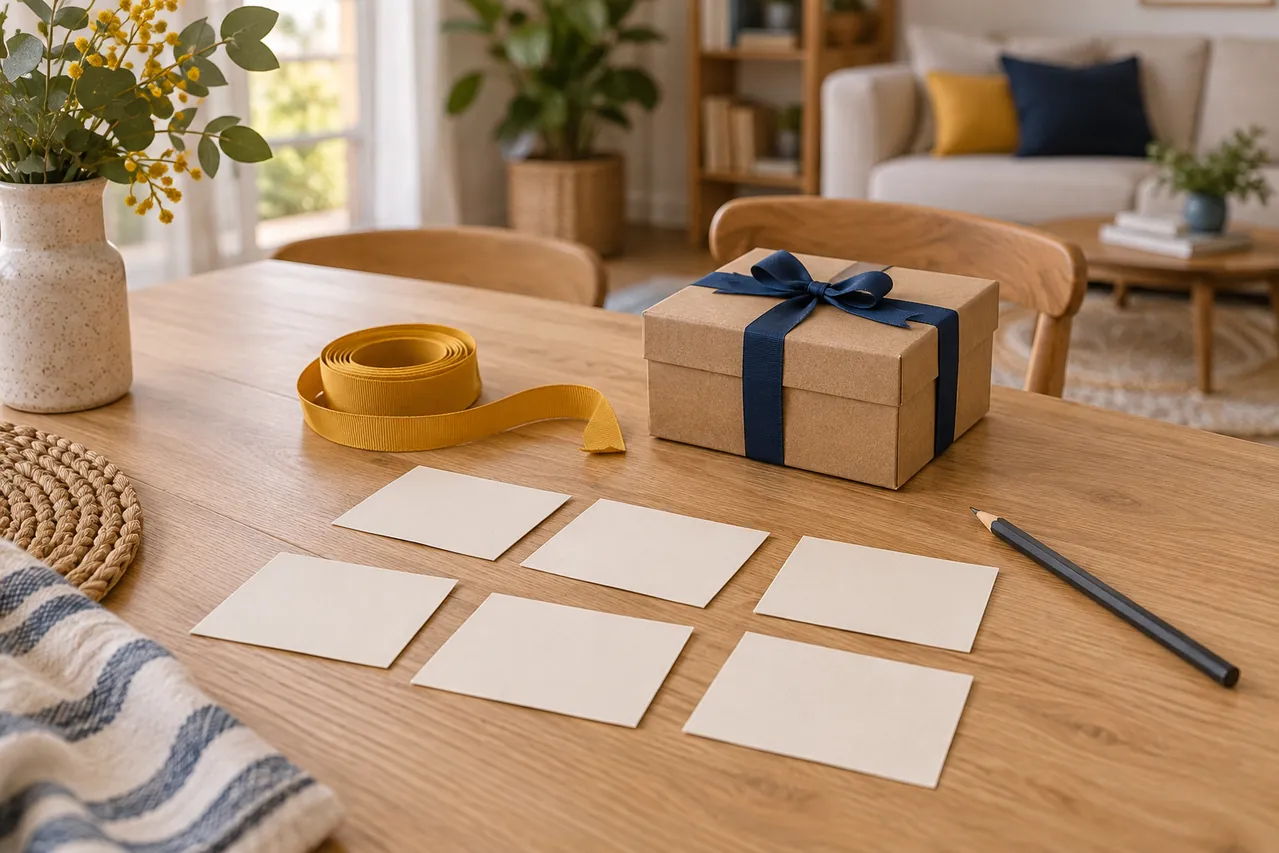
You can set up this indoor treasure hunt with six clue cards, everyday objects and a box marked with a star. The trail leads to a shoe, a cushion, a book, a table, a coat and finally the treasure. Below are the exact clues to copy and the placement instructions, so you do not have to invent riddles while the children wait.
The story is simple: “The story box has lost its way. Six objects in this house are keeping the directions to find it.” Everyone searches together and can ask for a hint. The treasure can be a story chosen by the group or a note suggesting your next activity; you do not need new toys or party supplies.
Prepare the playing area first
Choose an area where you can accompany the search. Put the six objects within everyone’s reach: the coat can lie on a chair and the treasure box on a low table. Remove medicines, cleaning products and fragile items from the playing area. Do not hide cards beside sockets, inside appliances or anywhere that requires climbing.
You need paper, a pencil, six cards and the final box. Draw a large star on the box; that is the sign in the last clue. Choose one book, mark its cover with a smaller star and tell the players: “We are looking for the marked book.” This avoids emptying a bookshelf or searching through someone’s personal books.
Six clues ready to copy
For the organiser: hand out card 1 at the start. Players should see only their current clue; keep the answers and placement instructions for yourself. Each row tells you where to put the next card after they solve that clue.
| Card | Text for the players | Answer and placement |
|---|---|---|
| 1 | “I go on walks but cannot take a step. Your foot fits inside me; at home I get a rest. Find one of my companions.” | Shoe. Put card 2 inside a clean shoe selected for the game. |
| 2 | “I am not a bed, but I make resting cosy. On the sofa you can give me a hug. Lift me gently.” | Cushion. Put card 3 under a sofa cushion. |
| 3 | “I have leaves but I am not a tree. I hold a story without speaking. The star on my cover shows which one is me.” | Marked book. Put card 4 between its first few pages. |
| 4 | “Plates rest on me and drawings happen here. Do not look underneath: the next clue is waiting in plain sight on my back.” | Table. Put card 5 visibly on the chosen table. |
| 5 | “I have sleeves but I am not a person. When it gets chilly, I come along. Look for a note beside my pocket.” | Coat. Put card 6 beside a pocket, with the coat within reach. |
| 6 | “Not under a bed and not behind a door: the box with the star holds what you are looking for.” | Marked box. Put the final treasure inside. |
These clues are an original game script proposed by Buscatea. They are not materials from a museum, a games company or UNICEF. You can swap an object, but change its riddle and the position of the next card too; otherwise the trail stops working.
Test the whole trail before starting
Follow it yourself: card 1, shoe, card 2, cushion, card 3, book, card 4, table, card 5, coat, card 6, box. Check that every card is in the right place. Numbering the backs helps correct a mix-up without showing players the answer.
If there are several shoes or cushions, mark the chosen one with paper tape. Solving the clue should be the challenge, rather than searching through half the house. For a one-room version, bring all the objects into that room before play begins.
Keep everyone involved
Rotate three jobs at each stop: reading or listening, suggesting an answer and collecting the card. If someone does not read yet, another player can read aloud without solving the riddle for them. Before moving, ask: “Which object do we think it is?” Give everyone a moment to contribute, including people who need longer to answer.
When a clue becomes frustrating, offer a specific hint: “It is in the living room” or “It is something soft.” If that does not help, reveal the object and move on. UNICEF’s discussion of play suggests helpful hints in hiding-and-finding activities. It is a general reference here, rather than a promise of educational results from this particular script.
Adapt the game to your group
- Without reading: add a drawing of the next object to each card and read the words aloud.
- With less movement: arrange all the objects on an accessible table and hide the cards among them.
- For another round: change two objects and invite the players to write their replacement riddles afterwards.
You do not need darkness, blindfolds or a race to make the game interesting. Change the story instead—a box from a spaceship or an animal library—while keeping the same trail. If the game is part of a party, our guide to birthday parties with curious play helps combine it with other activities.
Common questions
Do I need a printer?
No. Copy the clues onto six pieces of paper. If printing, separate the clue text from the preparation key; do not give players the answer table.
How long should it last?
For a three-clue version, put the treasure beside the marked book, which is the answer to clue 3, and do not use cards 4, 5 or 6. The hunt ends when the group finds the book and treasure. There is no timer; finish while everyone is enjoying it.
What should the treasure be?
A note offering a choice of story, song or another shared game works well. Prepare something simple so finding the box finishes the adventure rather than starting another long wait.
Reference for playing together
UNICEF Parenting: The science of play. The six clues, story and preparation sequence in this article are original.
Sources checked on 12 October 2026. Check the official sources for details that depend on your date, garment, footwear or app version.