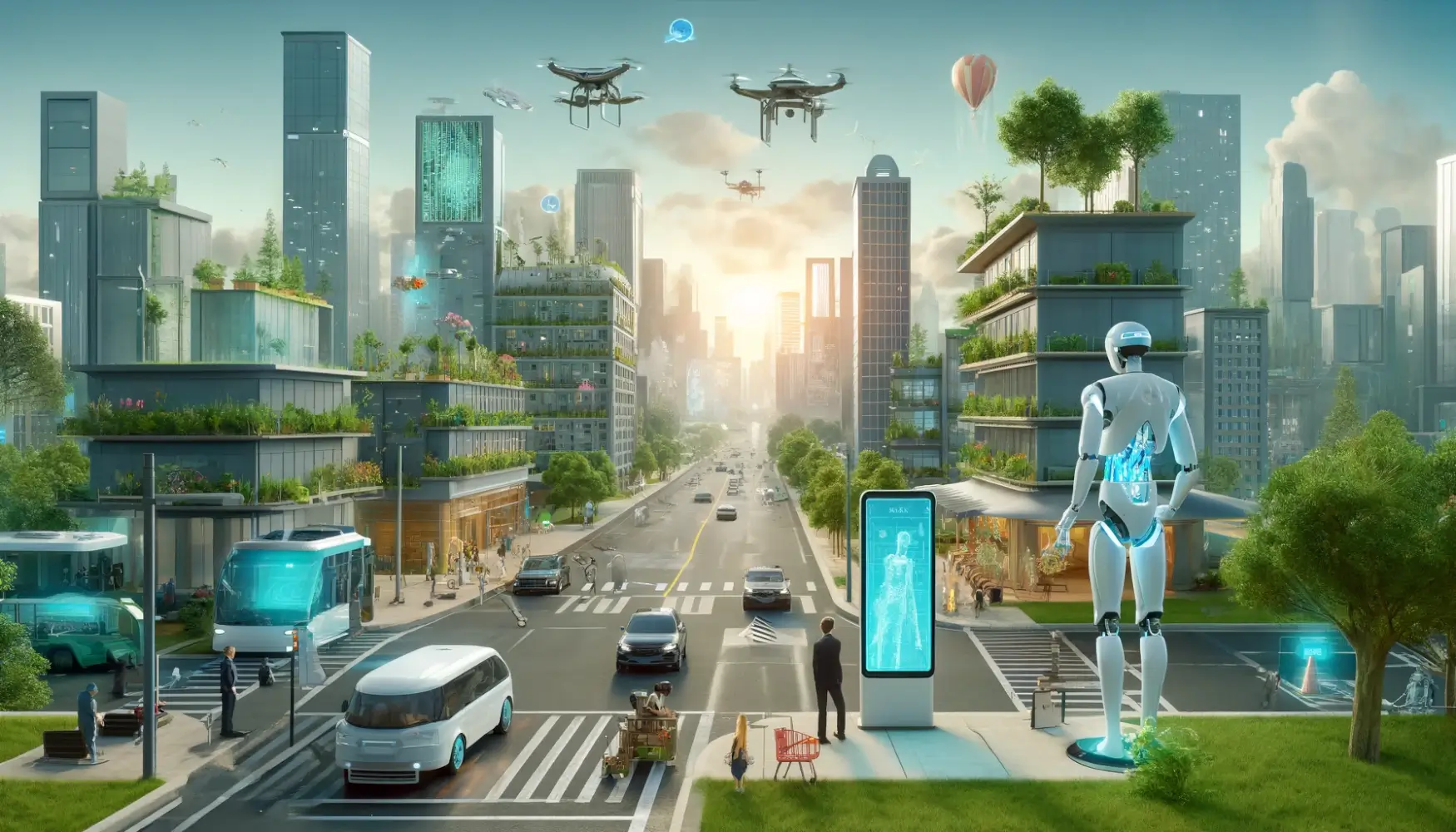
Digital illustration of an imaginary city; not a photograph of 2025.
2025 is over. The original article imagined changes in medicine, transport, work and cities without establishing that they would all happen that year. This revision asks a more useful question: what can be checked, and which expectations were too broad to test?
Health AI: potential is not proven effectiveness
WHO identifies possible health applications for generative models while warning about false, incomplete and biased responses. Fluent wording does not demonstrate diagnostic accuracy or make an application a substitute for professional care. The earlier promises of general disease prediction and reliable psychological support were too sweeping.
When reading about a health tool, ask what task was evaluated, in which patients and under whose supervision. A technical demonstration is not the same as a treatment available to everyone. This article does not provide a diagnosis or instructions for changing treatment.
Driving assistance is not the same as automation
NHTSA’s classification distinguishes different levels. At Level 2, assistance may control steering and acceleration or braking, while the person remains responsible for driving and monitoring. A car with assistance features should not automatically be described as autonomous or free from the need for human involvement.
For a purchase in Spain, check the particular model’s documentation and the functions authorised for its market. An overseas trial or development announcement does not necessarily describe what can be used locally.
A measurable example: renewable electricity in Spain
Red Eléctrica reports that renewables supplied 55.5% of Spanish electricity generation in 2025, or 56.6% when its self-consumption estimate is included. The distinction shows why a statistic needs a definition. These are electricity figures, not the share of all energy used in transport, industry and homes.
Work and education: avoid universal conclusions
The earlier text also forecast widespread hybrid work and digital education accessible from anywhere. Without a population, country and measure, those statements cannot establish how much changed. For your sector, compare employment or participation data and separate the existence of a platform from access to it and the results it produces.
Remote work can also mean different things in different reports: occasional days at home, a permanent arrangement or a role that permits it. A useful comparison uses the same definition at both dates.
A checklist for the next prediction
- Record the date, place and population it refers to.
- Separate a forecast from an observed result.
- Find the primary source and read its limitations.
- Check again when the promised year arrives.
A futuristic illustration may suggest possibilities; it is not evidence of how people actually lived in 2025.
Sources and review
Sources checked on 23 September 2026. The original address and publication date are retained. More reading in Buscatea guides.