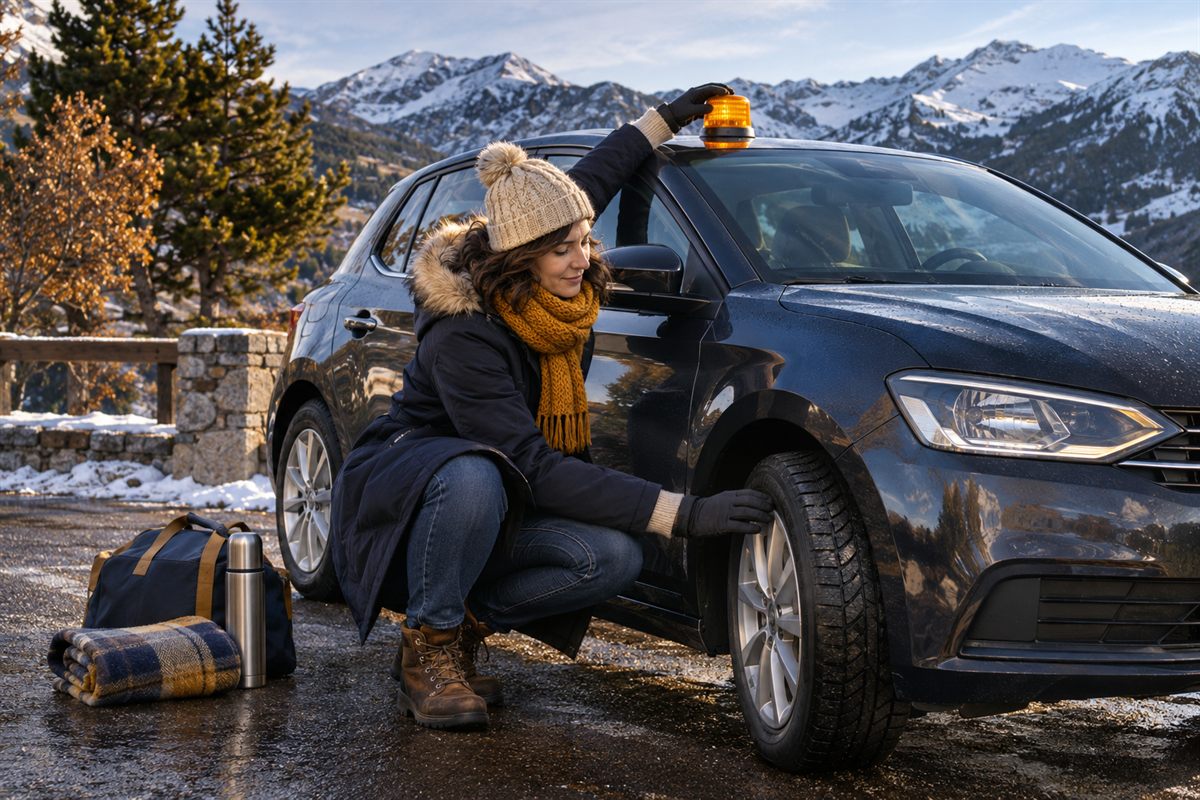
Before a winter drive in Spain, check the car, review weather and traffic along the route, and keep a certified connected V-16 beacon within reach. Since 1 January 2026, Spain’s DGT recognises the connected V-16 as the warning device for Spanish vehicles required to carry one.
A familiar journey can feel very different in rain, fog, frost or snow, especially after dark and on mountain roads. Use this as a preparation list, not as a substitute for your vehicle handbook or live traffic instructions.
1. Check the route before setting off
Check the forecast and road conditions through the Spanish Directorate-General for Traffic (DGT). The DGT advises postponing a journey when conditions are unfavourable and doing so is possible. If you travel, allow for delays and consider a safer alternative route or stopping point.
Look beyond the weather in your departure city: check mountain sections, passes and places where snow, ice or fog may affect the road. Conditions can change while you are travelling, so check again before leaving and follow road signs and instructions from traffic officers.
2. Give the car a quick check
The DGT recommends paying particular attention to the brakes, lights, wiper blades, windscreen wipers and rear-window demister before autumn and winter. Check the fluid levels listed in your handbook, too. Clean the windows, headlights, rear lights and mirrors: being able to see and be seen matters when daylight is shorter.
- Tyres: check the pressure recommended for your vehicle, tread wear and visible damage. The DGT cites 1.6 mm as the minimum tread depth. If you notice uneven wear, a bulge or a crack, ask a tyre professional before travelling.
- Brakes and lights: do not ignore a warning light, a change in braking or a failed lamp. Arrange a professional check if you cannot identify the problem.
- Visibility: test the wipers, demisting and washer fluid; clean both sides of the glass and check fog lamps as described in the handbook.
- Route-specific equipment: if traffic information forecasts snow or restrictions apply, follow the instructions about chains or suitable tyres. Do not wait until you reach a snowy road to learn how to fit chains compatible with your car.
Use the manufacturer’s maintenance schedule for mechanical checks. A travel checklist cannot assess the actual condition of a battery, brakes or the car’s heating system.
3. Check the connected V-16 beacon
Not every light advertised as a connected V-16 is valid in Spain. Before buying, compare the exact make and model with the DGT’s official list of certified devices. The page separates currently certified models from models whose manufacturing certificate has expired; the DGT says some devices bought while their certificate was valid may continue to be used for their service life.
Keep the beacon accessible and check its power source according to that model’s handbook. The DGT says it should be kept charged and within reach; battery or cell instructions vary by device. If your vehicle is immobilised, place it on the highest suitable exterior point only when it is safe to do so. Do not step into the carriageway to place it if the situation makes that unsafe.
The connected V-16 sends the vehicle’s position when activated; it does not need the driver’s phone or an external app to transmit it. The DGT also clarifies that the beacon does not itself contact emergency services. Occupants should contact the relevant services when they can do so safely if assistance is needed.
4. Adjust your driving to the conditions
Rain, fog, ice and snow can reduce visibility or grip. Slow down, leave more space and avoid sudden manoeuvres. The DGT’s winter-driving guide advises extra caution. If conditions make driving dangerous, stop in a suitable place off the carriageway and wait for them to improve.
If the trip is no longer safe, arriving on time is not the priority. Follow traffic instructions and use an authorised stopping place. Do not stop in a live lane or continue towards a closed road to “see how it goes”.
A quick checklist before you go
- Forecast and traffic checked for the whole route.
- Tyres, brakes, lights, wipers and demisting checked.
- Certified connected V-16 accessible, with its power source checked.
- Chains or other equipment chosen only when route conditions require them.
- Time allowed to stop or postpone if the weather worsens.
Common questions
Will any V-16 beacon do in 2026?
No. Check that the exact connected model appears on the DGT’s official list. The word “connected” in an advert is not proof of certification.
Does the V-16 call emergency services?
No. The DGT says it is not an eCall or emergency-call system. It reports the location of an immobilised vehicle; people must contact the appropriate services through the usual channels when it is possible and safe.
Do I need to carry snow chains on every trip?
There is no one-size-fits-all recommendation for every route and condition. Check the forecast and any restrictions; when the authorities require specific equipment, follow their instructions and make sure it suits your vehicle.
Official sources
- DGT: traffic advice and vehicle checks
- DGT: connected V-16 use and certified models
- Traffic and Road Safety magazine: winter driving
Sources checked on 3 November 2026. Road rules and conditions can change; check the DGT before each trip. AI-generated editorial illustration of a fictional scene, not a documentary photograph.