Image: AI-generated editorial illustration; a fictional scene with no real businesses.
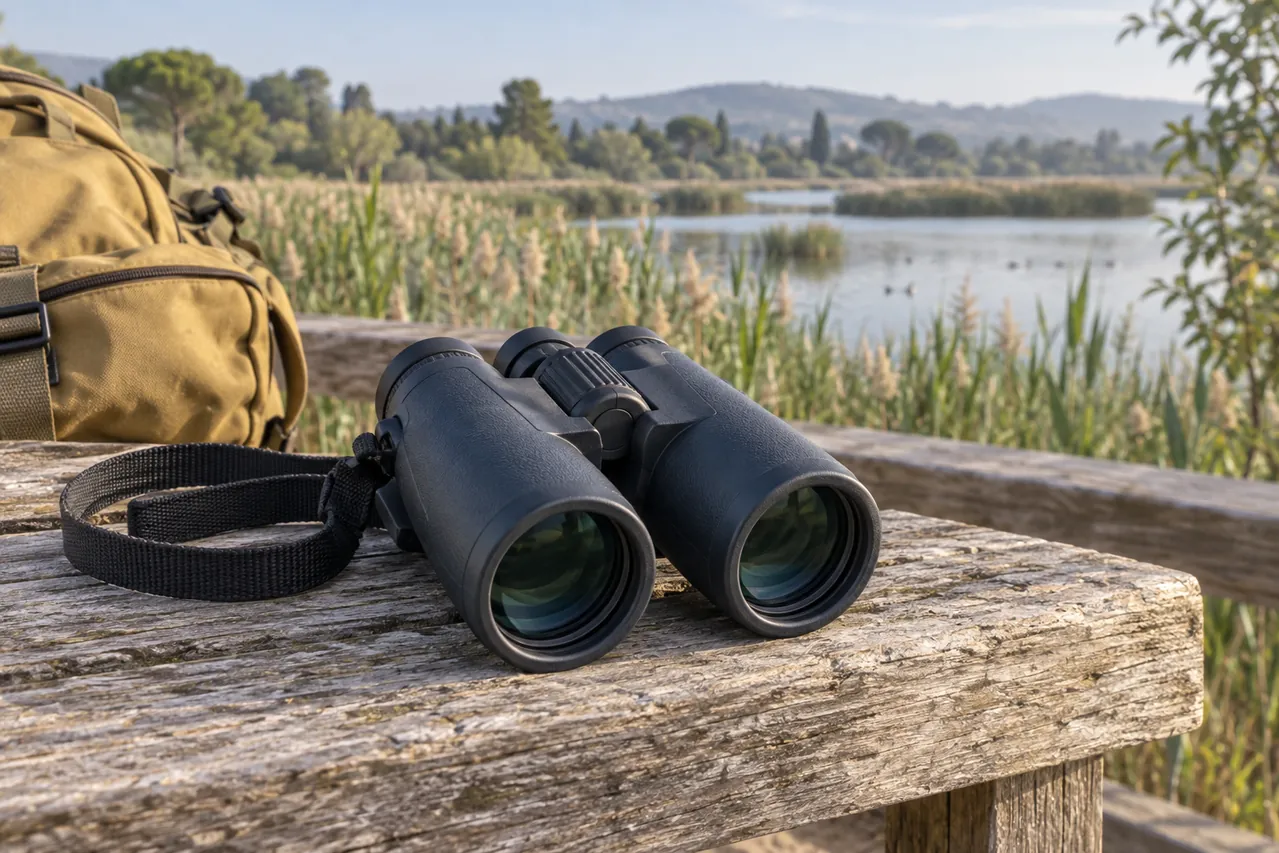
When choosing your first binoculars, begin with a practical question: can you find an object, focus on it and keep it in view comfortably? Magnification matters, but a shaky image or equipment you always leave at home may not be very useful.
You do not need to buy anything before trying birdwatching. Borrowing a pair can help you discover what weight you enjoy carrying and whether you like looking for birds or details in the landscape. This is a repeatable hands-on check, not a brand ranking.
What does 8×42 mean?
The first number describes magnification; the second is the diameter of the front lenses in millimetres. The RSPB buying guide puts those numbers alongside weight and field of view. They are not a quality score: two pairs with the same specification can feel quite different.
Nikon suggests 6× to 10× for handheld outdoor use and explains that hand movement becomes more noticeable at high magnification. You might compare 8×32 and 8×42 options for comfort without assuming that the larger number automatically makes a better choice.
Try them as you would use them outside
If you wear glasses, keep them on for the test. Position the eyecups according to the manual and check that you can see a broad view without pressing the binoculars against your face. Eye relief matters, but the fit with your actual glasses is what you need to establish.
Nikon’s adjustment guide separates the distance between the barrels, central focusing and the dioptre adjustment. Follow the instructions for the particular model. Do not force a control past its limit, and ask for help with the initial adjustment if you have never done it before.
A short test worth repeating
- Choose a stationary object, such as a distant sign or branch, never the sun.
- Locate it with your eyes first, then raise the binoculars while keeping its direction.
- Focus and see whether a small detail is easy to identify.
- Lower them and repeat several times. Notice whether the movement feels natural.
- Hold them for a while and check that you can comfortably reach the focus wheel.
- Put them in the bag you would use on a walk. Bulk and weight are part of the choice.
Compare two pairs using the same object in similar conditions. If one looks worse, check its adjustment before drawing a conclusion about the entire brand.
Write down three observations
Your notes might say “easy to find the subject”, “full view with my glasses” and “happy to carry these for the walk”. Add the stated weight, close-focus distance if nearby subjects matter to you, and the manufacturer’s water-resistance conditions. A rubber covering is not evidence that a pair is waterproof.
Two boundaries for your walk
Never look directly at the sun through binoculars; doing so can seriously damage your eyes. Respect access rules and wildlife distance too. A closer view is not a reason to approach a nest or leave a marked path.
For a longer walking trip, decide how much equipment you want to carry before packing. Our guide to choosing a Camino de Santiago route starts with a similar principle: match the plan to your time and experience.
Sources checked on 2 October 2026.