Image: AI-generated editorial illustration; a fictional scene with no real businesses.
When one mug comes out clean and the next does not, the detergent may not be the problem. Look at whether water could actually reach both. A bowl covering another or a tray stopping the spray arm can leave food behind even on a long cycle.
Racks differ between machines. Follow your own manual for special holders and materials; the checks below help with an ordinary load without assuming every dishwasher is built the same way.
Scrape large scraps; skip the full pre-wash
Remove bones, napkins and large pieces that could obstruct the filter. Bosch’s cleaning guidance says dishes do not need to be rinsed before loading. Dried-on food may call for a suitable programme, but washing every plate under the tap first adds another job.
Give each dirty surface a route to the water
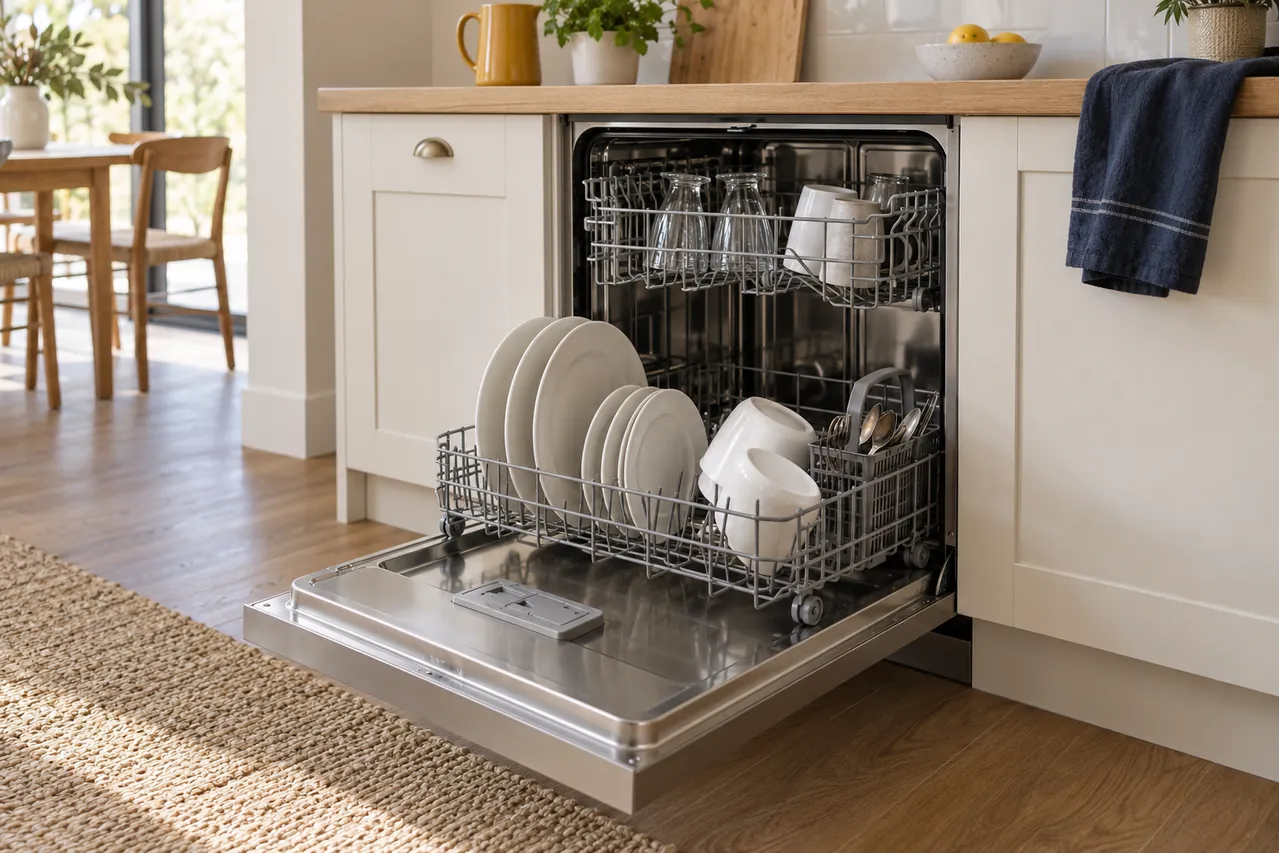
Stand plates separately in their slots rather than stacking them face to face. Angle bowls and pans so the insides face the jets and water can drain. Cups, glasses and lighter containers usually belong in the upper rack, secured so they cannot flip. Check manufacturer advice before putting delicate or uncertain items through a wash.
A Bosch user manual emphasises stable placement and facing the insides of containers towards the spray arms. A large tray should not form a roof over smaller dishes. Before closing, gently turn the accessible spray arm and see whether a long spoon or board stops it.
Keep cutlery from nesting
If your machine has a basket, mix and separate pieces so two spoons do not fit together like a shell. If it has a top cutlery tray, use the dividers. Follow the manual’s safe placement for sharp ends, and wash unsuitable knives or fragile handles by hand.
Four checks before pressing Start
- Make sure a tray does not block the detergent compartment as it opens.
- Check that spray arms rotate and nothing protrudes beneath a rack.
- See that cups and lighter items are secure, with openings downwards or angled to drain.
- Choose a cycle suited to the dirt and materials, using your machine’s manual.
If the same section repeatedly comes out dirty, check the filter and spray arms as the manual directs before buying a new detergent. For a small kitchen, our guide to essential cooking utensils can help keep your everyday collection manageable.
Is a completely full machine always better?
Only when the dishes stay exposed to water and do not obstruct moving parts. Two sensible loads are more useful than one packed load you have to wash again.
Sources checked on 5 October 2026.