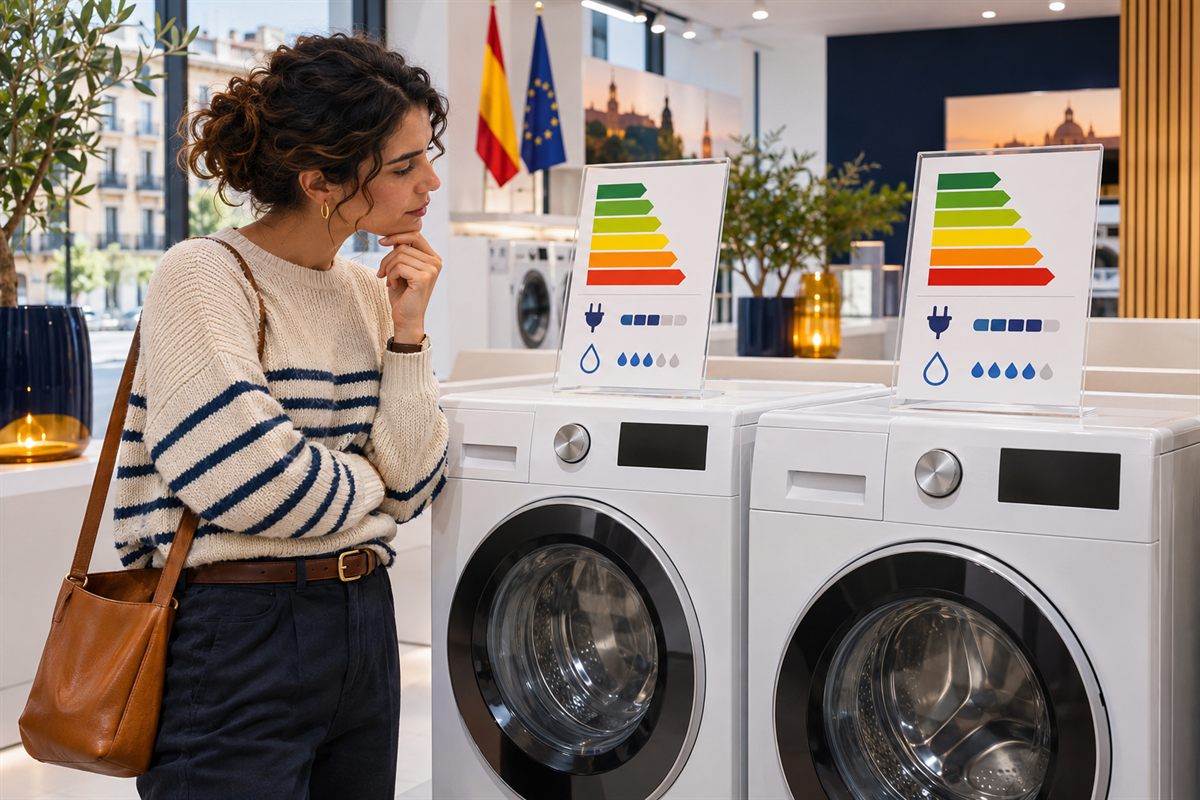
To compare washing machines, look beyond the letter: check kWh per 100 cycles, water per wash, capacity and programme duration. The current EU label uses an A-to-G scale and reports standardised figures for the Eco 40–60 programme.
Two machines can look similar in a shop and suit very different households. This guide explains how to read the label and compare models; it does not recommend a brand or claim to predict everyone’s bill.
Start by checking that the products are comparable
Note the exact model name and number, and distinguish a washing machine from a washer-dryer. Their labels and intended use are not interchangeable. Since 1 March 2021, EU household washing-machine labels have used an A (most efficient) to G (least efficient) scale, rescaled to make comparisons clearer.
If a product listing highlights an old A+++ class or combines figures from different label scales, do not compare that letter directly with a current A–G label. Check which label applies to the exact model and when it was placed on the market.
What each label figure tells you
- Energy class, A–G: a guide to efficiency under the standardised test. It is a useful first filter, not a rating of cycle length, size or convenience.
- kWh per 100 cycles: weighted energy use for 100 reference cycles of the Eco 40–60 programme. For a simple estimate, multiply the figure by the cycles you expect to run in a year and divide by 100. The result is still an estimate: your programmes, loads and temperatures may differ.
- Water per cycle: water use for one Eco 40–60 cycle in the label test. It does not mean every programme uses exactly that amount.
- Capacity: the maximum mass of dry laundry the model can treat in one cycle when loaded according to the manufacturer’s instructions. More capacity is not automatically better if you rarely need it.
- Duration: the label shows programme time at rated capacity. Check that Eco 40–60 fits your routine; it can prioritise efficiency even when the cycle takes longer.
- Spin and noise: the spin-drying class helps compare how much moisture remains after spinning; the noise figure relates to the spin phase.
Use the QR code to confirm the model
The label’s QR code links to the European Product Registry for Energy Labelling (EPREL), where you can check the registered model information. Before relying on a printed label or shop photo, make sure the brand and model reference match. The European Commission explains how to recognise the official EPREL address. If the code leads somewhere unexpected, ask the retailer for the correct product sheet rather than entering personal details or downloading files.
Compare the machine you will use, not an abstract letter
Write down three real needs: how much laundry you usually wash, how much space you have, and any noise or cycle-time limits that matter at home. Then compare models of the same type on energy, water, capacity and spin performance. A higher class may look appealing, but the appliance also needs to fit the space, your usual load and the way you plan to use it.
The label is not a replacement for the manufacturer’s full product sheet. Check dimensions, connections and installation requirements, programmes you will actually use, warranty terms and spare-part availability. EU ecodesign rules include availability requirements for certain parts of washing machines and washer-dryers; if repairability matters to you, check the model and supplier terms.
Once you own the machine, the care instructions on each garment remain the reference for choosing a cycle. See our guide to reading a clothing care label.
A simple comparison checklist
- The brand, model and appliance type match the label.
- Capacity suits the amount of laundry you usually wash.
- You have noted kWh per 100 cycles, water per wash, duration and noise.
- The QR code or registration number leads to the matching EPREL product sheet.
- Dimensions, installation, warranty and parts availability suit your situation.
Common questions
Does class A guarantee the cheapest washing machine?
No. The class summarises efficiency under the label test. Purchase price, capacity, the programmes you use and model-specific features matter too. The label does not predict your exact bill.
Which programme is used for the energy figure?
The label information is based on Eco 40–60. The European Commission explains that energy is shown per 100 cycles and water per cycle. Other programmes and habits can produce different results.
Can I compare a washer-dryer directly with a washing machine?
It is better to compare products of the same type and check the model sheet. If an appliance also dries clothes, review the separate label and consumption figures for the drying function.
Official sources
- European Commission: washing-machine energy labels
- European Commission: understanding the label and using EPREL safely
- European Commission: finding a model’s label in EPREL
Sources checked on 3 November 2026. Label figures come from standardised tests and do not predict the exact energy use or cost in every home. AI-generated editorial illustration; the washing machines and labels shown are fictional.