Image: AI-generated editorial illustration; a fictional scene with no real businesses.
To start a 1,000-piece jigsaw, check the finished dimensions of your particular puzzle and prepare a surface you can leave in place or put away. Then set up a small working area and choose a recognisable part of the picture. Knowing how to stop is as useful as deciding where to begin.
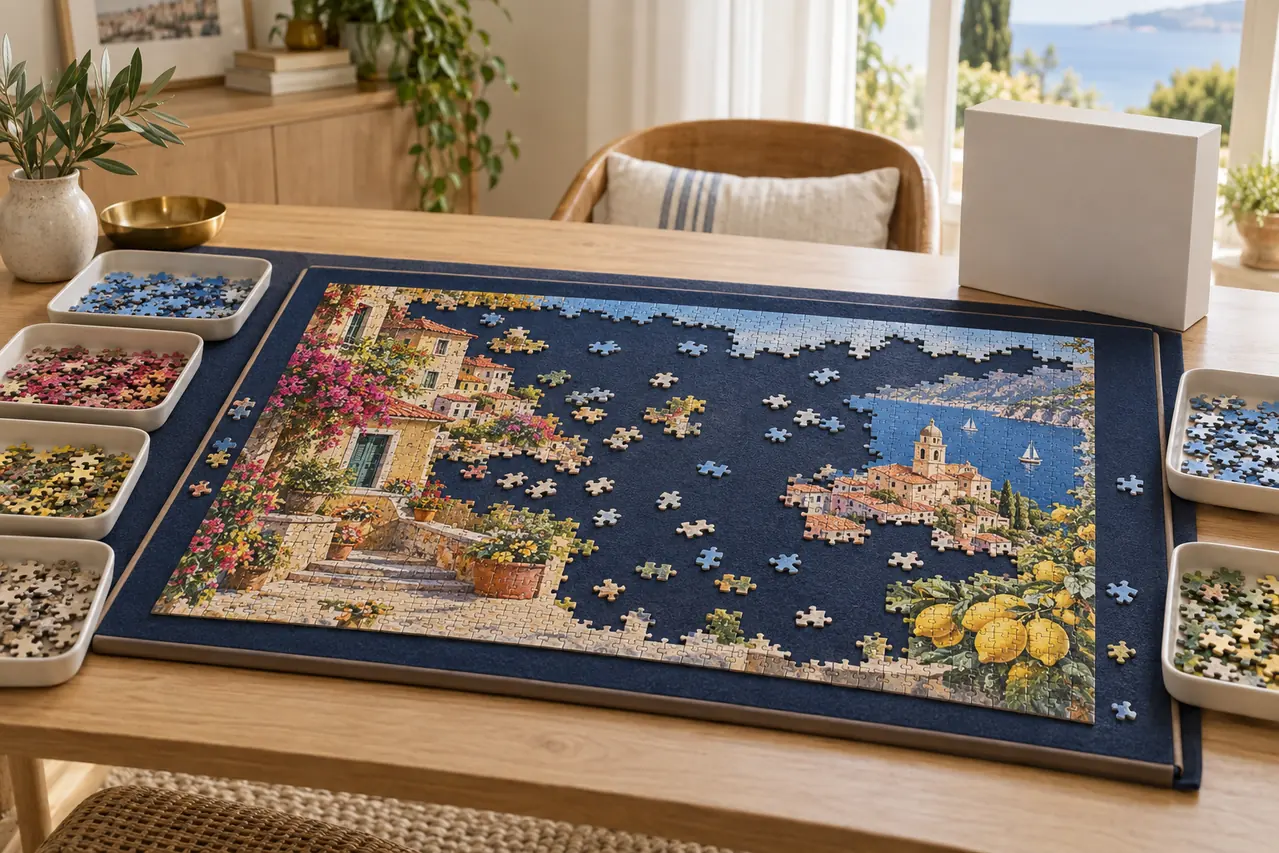
Picture opening the box after dinner, covering the table in pieces and remembering that you will need it for breakfast. Solve that space problem before hunting for the first corner.
Measure the board and choose its resting place
Read the finished dimensions on the box or the product information for your model. Not every 1,000-piece puzzle is the same size. If you use a board, allow for the completed picture and enough margin to work comfortably.
Try moving the empty board to its storage spot first. Something that fits under a piece of furniture may be awkward to carry through a doorway. To move the unfinished puzzle, use a suitable rigid board or a storage system according to its instructions; an improvised sheet of thin cardboard can bend.
Give the first session a small objective
- Set the reference picture where you can consult it without continually lifting the box.
- Turn pieces face up in batches. Use shallow trays for pieces you are not placing yet.
- For a conventional rectangular puzzle, separate edges and corners. Adapt the plan for an irregular outline.
- Pick an identifiable area: a door, an object or a clear change of colour. You do not have to finish the entire border before making progress elsewhere.
Avoid making twenty sorting groups that become a task in themselves. Start with a few trays and one for uncertain pieces. When a piece has no obvious destination, put it there instead of repeatedly interrupting the assembly to study it.
When two pieces seem to fit
Check that both the picture and the joint continue correctly, without forcing the pieces. A similar colour is not enough. Keep a doubtful cluster separate from the main assembly until you have more reference points.
Ravensburger explains that image and cut also affect difficulty: uniform areas and repeating patterns offer fewer clues. Do not judge the whole session by the time spent on one of those sections.
Leave a clue for your next session
Before packing up, photograph your progress and note one specific task: “look for the yellow window pieces”. Store loose pieces in containers you can close, away from food and drinks. Keep the box and its warnings; keep small pieces out of reach of children who might put them in their mouths and away from pets.
If the surface reflects your lamp, adjust its position before continuing. Our home reading-light guide includes a simple check for reflections from your seat.
Do I have to begin with 1,000 pieces?
No. If you have not chosen a puzzle yet, look for a format that fits your space and a picture you want to spend time with. If you already own it, work in short sessions without setting a finishing deadline. For another tabletop activity, try our first chess session at home.
Sources checked on 29 September 2026.